Understanding the Grenadier: A Journey Through Military History
When I hear the word 'grenadier,' my mind immediately conjures images of powerful, imposing soldiers, often in distinctive headwear, ready to face the fiercest of battles. But what exactly is a grenadier? And how did this specialized military role evolve over centuries? It's a fascinating story, one I'm eager to walk you through, from the chaotic battlefields of early modern Europe to the elite formations of today.
My exploration begins, quite naturally, with the very object that gave them their name: the grenade. Back in the 17th century, when gunpowder technology was still finding its footing, handheld explosive devices were making their appearance on the battlefield. These early grenades, often ceramic or cast iron spheres filled with black powder and fitted with a fuse, were a bit unwieldy. Throwing one accurately and safely in the heat of battle wasn't for just anyone. It required a special kind of soldier – someone strong, brave, and, frankly, a little daring. That's where the first grenadiers came in.
The Birth of a Specialist: Early Grenade Throwers
Imagine, if you will, a battlefield in the mid-1600s. Line infantry were firing their muskets, bayonets fixed, but there was a need for something more to break enemy formations or clear fortifications. Enter the grenade. These weren't the sleek, pin-pull devices we know today. Oh no. These were hefty, roughly spherical objects. Lighting a fuse and lobbing one accurately into enemy ranks took guts and a steady hand. You couldn't just have any grunt doing it; the risk of an accidental detonation or a poorly aimed throw was too high. So, armies started selecting their tallest, strongest, and most courageous men for this dangerous task. These were the true originators of the grenadier role.
These early grenadiers weren't just strong; they were often seen as something of a shock troop. Their job was to lead assaults, throwing their explosive projectiles to disrupt enemy lines before the main infantry advanced. It was a high-risk, high-reward proposition. The British Army, for instance, established its first regiments of grenadiers around 1678, acknowledging the specialized nature of these troops. They quickly became an integral part of battle formations across Europe.
Equipment and Distinguishing Marks
What did these guys wear and carry? Well, aside from their muskets and bayonets, they carried a haversack full of grenades. The fuses had to be lit, so they often had a slow-burning matchcord or a specific lantern for that purpose. This made them visually distinct on the field. But the most iconic piece of their kit, I think, has to be the mitre cap.
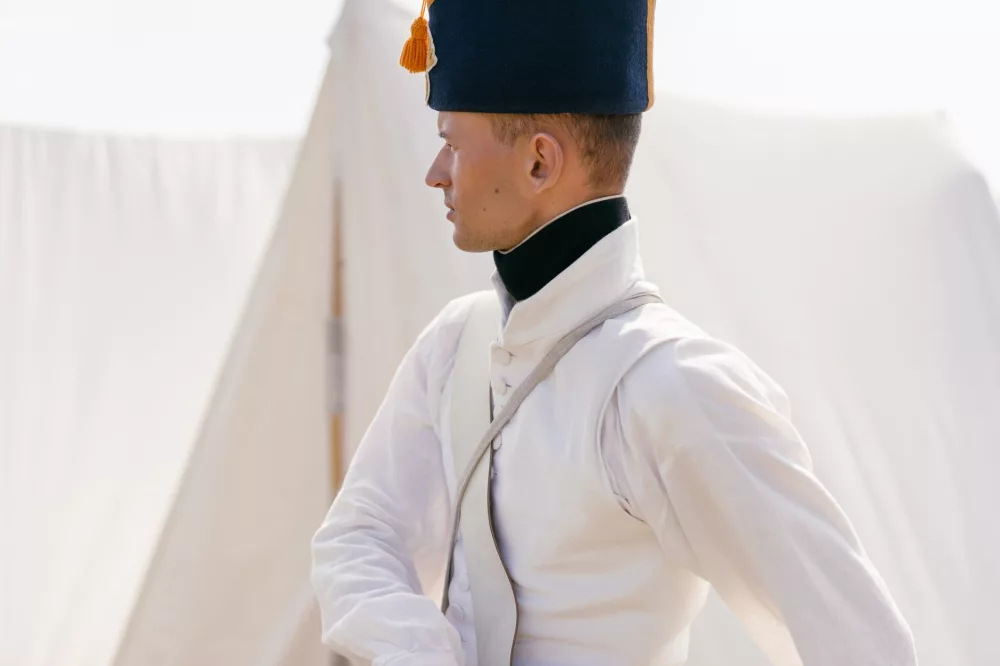
- The Mitre Cap: You see, the standard wide-brimmed hat of the period just wasn't practical for throwing grenades. It got in the way. So, a tall, conical, or mitre-shaped cap was adopted. This allowed for a full range of motion when throwing, and it also had the added benefit of making grenadiers look even more imposing and, frankly, taller than they already were. It became a symbol of their elite status.
- Musket and Bayonet: Like other infantry, they carried a musket, often a slightly shorter, handier version for easier maneuverability.
- Grenade Pouch/Haversack: Essential for carrying their primary weapon.
- Matchcord/Ignition Device: Crucial for lighting the grenade fuses.
Their training focused not only on musketry and bayonet drills but, obviously, on the safe and effective handling of grenades. They'd practice throwing from various positions, understanding the arc and timing needed to maximize impact while minimizing friendly fire. It was a demanding specialization, one that set them apart.
From Grenade Throwers to Elite Infantry
As the 18th century progressed, the utility of handheld grenades in open-field battles started to wane. They remained useful for siege warfare and close-quarters combat, but the technology wasn't advancing fast enough to keep pace with changes in linear tactics and improved firearms. Yet, the grenadier companies didn't disappear. Quite the opposite! The reputation they had earned – as strong, brave, and disciplined soldiers – ensured their continued existence.
What happened, then, was a transformation. Grenadiers ceased to be just grenade throwers and evolved into the premier infantry companies within regiments. Every infantry regiment in many European armies would have a grenadier company, typically comprising the best, most experienced, and physically imposing soldiers. They were often placed on the flanks of the battle line, where they could lead charges or hold critical positions. Their distinctive caps, even if the grenades themselves became less common, remained a badge of honor, signaling their elite status.
Think of Napoleon's Imperial Guard, for example. The Grenadiers of the Old Guard were absolutely legendary. These weren't just guys with big arms; they were veterans, tried and true, the toughest soldiers in the army. They wore their tall bearskin caps with pride, and their presence on the field was often enough to inspire fear in opponents and confidence in their comrades.
Modern Echoes and Other Meanings
While the traditional grenadier role of a soldier solely dedicated to throwing handheld explosives largely faded, the term itself persisted in different forms. In many modern armies, infantry units might still be designated 'grenadier' to signify a certain heritage or elite status, even if their primary weapon is an assault rifle with a grenade launcher attachment rather than a historical hand grenade. You'll find 'grenadier' battalions or regiments in various contemporary forces, often elite or ceremonial units, carrying on a proud tradition.
And, just to make sure we cover all bases, it’s worth noting that 'grenadier' also refers to a family of deep-sea fish, known for their large heads and long, tapering bodies. I'm talking about the Macrouridae family, often called rattails. They live in the abyssal plains, a world away from musket smoke and battlefields, but share a name with these historical warriors. It's funny how language works sometimes, isn't it?
So, from the daring soldiers lobbing dangerous explosives to the revered elite infantry and even to a deep-sea creature, the word 'grenadier' certainly has a rich and varied history. For me, tracing its evolution truly helps us appreciate the fluidity of military roles and the enduring power of reputation in shaping perceptions of a soldier.